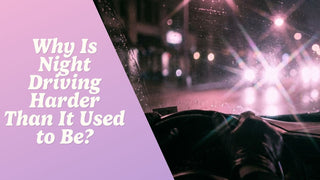


You're on the highway at night. An oncoming car blasts you with its headlights and instead of two clean beams of light, you see a blinding starburst — rays shooting in every direction, making it hard to focus on the lane ahead. You blink. It doesn't help. Sound familiar?
If you've had that experience, there's a good chance astigmatism is the reason. It's one of the most common refractive errors out there, and it has a particularly pronounced effect on nighttime vision.
Here's exactly what's happening in your eye, why darkness makes it worse, and what you can do about it.

What Is Astigmatism, and Why Does It Affect Vision?
A normal cornea is shaped like a basketball — uniformly curved in all directions, so light bends consistently and lands cleanly on a single focal point on your retina. With astigmatism, the cornea (or sometimes the lens) is shaped more like a football — steeper in one direction than the other. That irregular curve means light coming into your eye doesn't converge at one point. Instead, it scatters, landing at multiple locations on your retina simultaneously.
The result: everything looks slightly blurred or distorted, at multiple distances. Astigmatism is a refractive error, not a disease, and it's extremely common. It often coexists with myopia (nearsightedness) or hyperopia (farsightedness), which is why many prescriptions include a CYL (cylinder) value alongside the standard SPH power.
Why Night Makes Astigmatism So Much Worse
Astigmatism doesn't suddenly get stronger after dark — but its effects become dramatically more visible. Here's why.
In low-light conditions, your pupils dilate to let in more light. This is your eye's way of compensating for darkness. But a wider pupil means more peripheral light enters the eye. For someone with a normally curved cornea, that's fine. For someone with an irregularly shaped cornea, a wider aperture means more of the aberrated surface is in play — and the scattering effect intensifies.
On top of that, nighttime driving involves high-contrast light sources: headlights and streetlamps punching against a completely dark background. That contrast makes distortions far more noticeable than they'd be in diffuse daytime light. Glare from a headlight in daylight is an annoyance. Glare from a headlight against a pitch-black road is a genuine visual event that takes your focus off the road.

What You Actually See — The 3 Main Distortions
People with astigmatism tend to describe three specific visual effects around light sources at night:
- Halos Glowing, fuzzy rings that encircle headlights or streetlamps. They expand outward from the light source and can make it harder to judge how far away a car actually is.
- Starbursts Radiating lines or spikes that shoot outward from a point of light, giving it a star-like appearance. These are especially distracting when an oncoming vehicle's headlights are aimed at you directly.
- Glare and reduced contrast sensitivity A general wash of brightness that bleeds into your visual field, reducing your ability to distinguish dark objects against a dark background. This makes it harder to see pedestrians, cyclists, curbs, or road hazards in poorly lit areas.
The specific pattern you see depends on the axis and severity of your astigmatism, so two people with the condition may experience slightly different distortions from the same light source.
How Severe Does It Get?
Mild astigmatism (under about 1.00 diopter) often goes unnoticed during the day and only shows up at night as a subtle softness around lights. Moderate to high astigmatism — roughly above 1.25 diopters when uncorrected — can meaningfully impact night driving performance, making it harder to read signs, spot hazards, and react to fast-moving light sources. Dry eyes, cataracts, and post-LASIK corneal changes can compound these effects even in people who have only mild astigmatism.
Is Night Driving With Astigmatism Dangerous?
Untreated, yes — it can be. Research has linked uncorrected astigmatism to reduced performance on nighttime driving tasks: slower sign recognition, harder hazard detection, and impaired ability to spot pedestrians. When glare from one oncoming car temporarily floods your vision, and you're simultaneously processing starbursts from a second vehicle, your brain has to work harder to interpret the scene — which slows your reaction time.
That said, this isn't a reason to panic. Most people with astigmatism drive at night without incident, especially with mild cases. But if you're regularly squinting, feeling visual fatigue behind the wheel after dark, or noticing those hallmark starbursts and halos, getting your eyes checked and your prescription corrected is the straightforward fix.
How to Correct Astigmatism for Clearer Night Vision
There are a few solid options depending on your lifestyle and severity:
Anti-reflective (AR) glasses
Glasses with an AR coating cut down on surface reflections that worsen glare. If you already wear glasses for astigmatism, make sure your lenses have this coating. It makes a meaningful difference at night.
Toric contact lenses
Toric lenses are contact lenses designed specifically for astigmatism. Unlike standard spherical lenses, they have two different powers built into a single lens — one to correct the refractive error, and one to correct the astigmatic distortion along a precise axis. They're designed with a weighted ballast system that keeps the lens in the correct rotational orientation on your eye, so the correction stays aligned where it needs to be. To buy toric lenses, you need a prescription that includes your CYL (cylinder) power and Axis values in addition to the standard sphere (power).
LASIK and other refractive surgeries
LASIK reshapes the cornea using a laser, which can permanently correct or significantly reduce astigmatism. This is often the most complete solution, though it comes with its own candidacy criteria, recovery period, and cost.

Can Colored Toric Contacts Help With Night Driving?
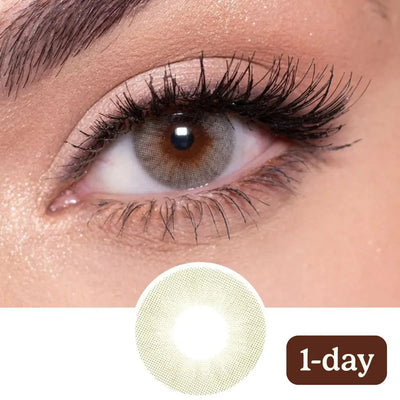
Yes — the toric correction works the same way whether the lens is clear or colored. Colored toric contact lenses give you the vision correction of a standard toric lens with the added cosmetic element of color. For anyone with astigmatism who wants to switch up their eye color without sacrificing their prescription, they're the answer.
EyeCandys stocks a selection of colored toric contact lenses that combine prescription correction with a range of lens colors and designs. You'll need a valid prescription from your eye doctor that includes your CYL and Axis values to order. If you already have that, the process is the same as ordering any colored contacts.
One practical note: some people with moderate-to-high astigmatism find that soft toric lenses don't fully eliminate their nighttime distortions, particularly at very high cylinder powers. In those cases, rigid gas-permeable (RGP) lenses or scleral lenses may offer sharper correction. Talk to your optometrist about what's appropriate for your specific prescription.


Other Tips to Reduce Glare While Driving at Night With Astigmatism
While vision correction is the most impactful step, these habits help too:
-
Clean your windshield
Smears, film, and dust on both the interior and exterior of your windshield scatter light exactly the way an irregular cornea does. A clean windshield alone can reduce perceived glare significantly.
-
Dim your dashboard
Bright instrument panels make your pupils try to constrict, which works against your eyes' need to adapt to the dark road ahead.
-
Don't drive fatigued
Eye muscle fatigue affects your eye's ability to manage incoming light and maintain focus. Night driving already demands more from your visual system; adding fatigue compounds the problem.
-
Update your prescription annually
Astigmatism can change gradually over time. An outdated prescription means your lenses are no longer correcting your actual corneal curvature, which makes every nighttime symptom worse.
Frequently Asked Questions
Does astigmatism always cause night vision problems?
Not always — mild astigmatism (under about 0.75-1.00 diopters) may not produce noticeable symptoms at night. But as severity increases, nighttime distortions like halos and starbursts become more pronounced and harder to ignore.
Can I wear colored contacts if I have astigmatism?
Yes. Colored toric contact lenses are specifically designed to correct astigmatism while providing a cosmetic lens color. You'll need a prescription that includes CYL and Axis values. EyeCandys carries colored toric options — ask your eye doctor about getting fitted.
Will my night driving improve immediately after getting toric lenses?
Most people notice significant improvement in halos and starbursts within the first few days of wearing properly fitted toric lenses. There can be an adjustment period as your eye acclimates to the rotational positioning of the lens.
What does astigmatism look like at night?
Lights appear surrounded by halos (glowing rings), starbursts (radiating spikes), or streaky comet-like tails. Overall contrast is reduced, making it harder to distinguish dark objects against a dark background.
Can LASIK fix astigmatism-related night vision issues?
For many people, yes. LASIK can correct the corneal irregularity that causes astigmatism, which reduces or eliminates the associated night vision distortions. However, a small percentage of patients experience temporary post-surgical halos or starbursts during healing.
Colored Toric Contacts — Style Without the Compromise
Astigmatism doesn't mean giving up on colored lenses. EyeCandys carries a full collection of FDA-cleared colored toric contacts — from subtle naturals to bold statement hues — all built to keep your prescription locked in and your look on point.