



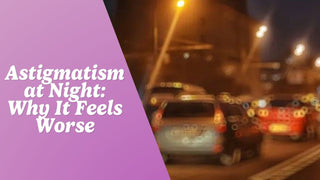
You are driving home after sunset, and every oncoming headlight blooms into a fuzzy starburst. Streetlights smear into halos. The lane markings look slightly doubled, and squinting only helps for a second before your eyes tire out again. If this sounds familiar, astigmatism could be a factor, and darkness has a way of making it far more noticeable than it is during the day.
What Is Astigmatism
Astigmatism is a common refractive error caused mainly by an irregularly shaped cornea, with the natural lens inside the eye usually adding only a minor share of a person's total astigmatism. Instead of a smooth, evenly curved surface like a basketball, an astigmatic cornea is shaped more like the back of a spoon, curving more steeply in one direction than another. Because a point of light entering the eye hits this uneven surface, it does not focus to a single sharp point on the retina. Instead, it focuses at two different points, producing blur at nearly every distance, according to answers from ophthalmologists at the American Academy of Ophthalmology. Astigmatism can occur on its own or alongside nearsightedness (myopia) or farsightedness (hyperopia), and it ranges from mild, barely noticeable cases to more significant degrees that affect vision throughout the day.
How the Eye Normally Focuses Light
In an eye without astigmatism, the cornea and lens work together to bend light so it converges neatly on the retina, producing one clear image. Every curve of a healthy cornea is proportional, so light rays entering from any angle land in roughly the same spot. Astigmatism disrupts that proportional curve. Vertical light rays might focus slightly in front of the retina while horizontal rays focus slightly behind it, or some variation of that mismatch. The result is not double vision in the way most people picture it, but a persistent softness or streaking that glasses, contacts, or surgery are designed to correct by compensating for the uneven curve.
Why Astigmatism Feels Worse After Dark
Astigmatism does not change between noon and midnight. The cornea keeps the same shape regardless of lighting. What changes is the pupil, and that single difference explains why so many people with mild or previously unnoticed astigmatism suddenly struggle once the sun goes down.

The Role of Pupil Dilation in Night Symptoms
In bright light, the pupil constricts to a small opening, which naturally blocks out much of the peripheral light entering through the more irregular, outer portions of the cornea. Only the central, more uniform part of the cornea is used to focus light, which minimizes the blur astigmatism causes. In dim light or darkness, the pupil dilates to let in more light so the retina can still register an image. Pupils can constrict to about three millimeters in bright conditions and widen to as much as nine millimeters in near-total darkness, depending on the person. That larger opening in darker environments exposes more of the astigmatic cornea's uneven curve, letting stray, poorly focused light rays reach the retina alongside the properly focused ones. The overlapping, misaligned light is what the brain interprets as glare, streaking, and halos.
Common Nighttime Symptoms of Astigmatism
People with astigmatism often describe nighttime vision using similar language: headlights that spread into starburst patterns, streetlights ringed with soft halos, road signs that look slightly doubled or ghosted, and an overall sense that everything looks "smeared" compared to daytime clarity. Eye strain and fatigue tend to build quickly during night driving, since the brain works harder to interpret an image that never fully sharpens. Some people also notice increased sensitivity to glare from oncoming headlights, illuminated signage, or even a phone screen in a dark room. These symptoms can appear even in people whose daytime vision seems perfectly normal, since mild astigmatism is often masked by pupil constriction in well-lit conditions.
Halos, Starbursts, and Glare Around Lights
Halos and starbursts are among the most distinctive nighttime symptoms of astigmatism, and they deserve their own explanation because they alarm a lot of people the first time they notice them. A halo is a diffuse ring of light surrounding a bright source, while a starburst adds radiating lines shooting outward from the light, similar to the way a bright star looks in a long-exposure photograph. Cleveland Clinic notes that halo vision around streetlights can stem from several causes, including cataracts, dry eye, and corneal irregularities such as astigmatism, all of which scatter light before it reaches the retina in a uniform way. Astigmatism produces this effect because the irregular corneal curve bends light unevenly rather than to one clean focal point, and the effect becomes far more pronounced once the pupil dilates.

Types of Astigmatism
Astigmatism is generally classified as corneal or lenticular, depending on which structure is irregularly shaped. Corneal astigmatism, the more common form and the one that contributes most to total astigmatism, involves an uneven curve on the outer surface of the eye. Lenticular astigmatism involves the internal lens instead, and the two can occur together. Astigmatism is also categorized by its axis: with-the-rule astigmatism, where the cornea is steeper vertically, tends to be more common in younger people, while against-the-rule astigmatism, where the cornea is steeper horizontally, becomes more common with age. Oblique astigmatism occurs when the steep and flat curves do not align at or near the vertical or horizontal axis.
Regular vs Irregular Astigmatism
Regular astigmatism follows a predictable, symmetrical pattern, where the two curves of the cornea sit exactly ninety degrees apart. This is the most common form and is easily corrected with glasses or standard toric contact lenses. Irregular astigmatism, by contrast, involves curves that do not sit at a clean right angle to each other, often caused by corneal scarring, an eye injury, or a condition called keratoconus in which the cornea gradually thins and bulges outward. Cleveland Clinic explains that irregular astigmatism can be more difficult to correct with standard lenses and sometimes requires specialty contact lenses or, in more advanced cases, surgical treatment. Distinguishing between the two types is a key part of an eye doctor's evaluation, since it directly shapes which treatment options will actually work.
How Astigmatism Is Diagnosed
Astigmatism is diagnosed during a comprehensive eye exam using a combination of tests. A keratometer or corneal topographer maps the curve of the cornea in detail, identifying exactly where it is steepest and flattest. A refraction test, the familiar "which is clearer, one or two" exercise, measures how light bends as it passes through the eye and helps the doctor calculate a precise prescription. Astigmatism is measured in diopters, with most people falling somewhere between 0.50 and 0.75 diopters of natural astigmatism. Even so, many people want these small amounts corrected, which is why toric contact lenses in 0.75 diopter powers are widely made and popular, while amounts above roughly 1.50 diopters typically require correction with glasses or contact lenses.

Treatment Options for Astigmatism
Astigmatism is highly treatable, and most people achieve clear, comfortable vision with the right correction. The starting point is almost always a proper prescription from an eye doctor, since guessing at correction or relying on outdated glasses tends to make nighttime symptoms worse rather than better. From there, treatment options range from simple corrective lenses to permanent surgical solutions, and the right choice depends on the degree of astigmatism, its type, and personal lifestyle factors like how often someone drives at night.
Corrective Lenses: Glasses and Toric Contact Lenses
Glasses remain the simplest and most common correction for astigmatism. Lenses are ground with a specific cylinder power and axis that compensates for the eye's uneven curve, redirecting light back to a single focal point on the retina. For contact lens wearers, standard spherical lenses cannot correct astigmatism because they curve evenly in every direction. Toric contact lenses solve this by incorporating different powers along different meridians of the lens, along with a weighting or stabilizing design that keeps the lens properly oriented on the eye with each blink. Because that orientation has to stay consistent, toric lenses require a more precise fitting process than standard lenses, and an eye doctor will typically check how well the lens rotates and settles before finalizing a prescription.
Surgical Options for Astigmatism
For people who want to reduce dependence on glasses or contacts, refractive surgery is another option. LASIK and PRK reshape the cornea with a laser to correct the irregular curve directly, and both procedures can treat regular astigmatism alongside nearsightedness or farsightedness in the same session. In the United States, LASIK and PRK are not approved to treat irregular astigmatism such as keratoconus. Toric intraocular lenses, used during cataract surgery, correct astigmatism at the same time the eye's clouded natural lens is replaced. Surgical correction is not right for everyone, and an eye doctor will evaluate corneal thickness, overall eye health, and the stability of the prescription over time before recommending it. Even after surgery, some people notice mild night vision changes during the healing period, which is one more reason a follow-up conversation with the surgeon about expectations matters.

Tips for Safer Night Driving With Astigmatism
While proper correction is the real fix, a few habits can reduce discomfort behind the wheel in the meantime. Keep the windshield clean inside and out, since dust and residue scatter light and intensify halos. Avoid staring directly at oncoming headlights; instead, glance slightly toward the right edge of the lane to keep peripheral awareness without the direct glare. Dim the dashboard display at night so the eyes are not adjusting between a bright screen and a dark road. If glasses tend to fog or glare from reflections, ask an eye doctor about an anti-reflective coating, which reduces the amount of stray light bouncing around the lens surface. Finally, build in extra following distance at night, since slightly delayed visual clarity means slightly delayed reaction time.
A comprehensive eye exam is worth scheduling if night driving has become noticeably harder, if halos or starbursts have appeared or intensified recently, or if it has been more than a year or two since the last vision check. Sudden changes in night vision, especially when paired with eye pain, redness, or flashes of light, warrant prompt attention rather than a wait-and-see approach, since those symptoms can point to conditions beyond astigmatism. Anyone whose current glasses or contact lens prescription no longer feels sharp, particularly at night, should not assume that is simply how their vision has to be. A quick refraction and corneal check can usually confirm whether astigmatism has changed or whether another factor, like dry eye or an early cataract, is contributing to the same symptoms.
Adjusting Headlights, Screens, and Ambient Light
Beyond personal habits, small environmental adjustments help too. If headlights on a personal vehicle seem unusually harsh to oncoming drivers, a mechanic can check the alignment, since misaligned headlights make glare worse for everyone on the road, astigmatism or not. Reducing phone and dashboard brightness before starting a nighttime drive gives the eyes time to adjust rather than shifting between a bright screen and dark surroundings, which temporarily worsens pupil dilation. At home, using warmer, dimmer lighting in the evening rather than harsh overhead lights can ease the transition into low-light conditions and reduce the jarring contrast that makes halos more noticeable once outside.

Final Thoughts
Astigmatism does not get worse after dark in any structural sense, but the eye's own response to low light, a wider pupil letting more of its irregular curve come into play, makes existing symptoms far more obvious. Halos, starbursts, and glare while driving at night are common, well-understood signs worth mentioning at the next eye exam rather than dismissing as normal. With an accurate diagnosis and the right correction, whether glasses, toric contact lenses, or a surgical option, most people find that night driving stops feeling like a guessing game and starts feeling ordinary again.
Prioritize Your Eye Health
Regular eye exams are the clearest path to comfortable, confident vision, day or night. If halos and glare have been creeping into evening drives, bring it up at the next appointment and ask specifically about how astigmatism may be contributing. For more guides on protecting and understanding your vision, follow @eyecandyscom on Instagram for ongoing eye health tips and updates.
Frequently Asked Questions
Is it normal for astigmatism to feel worse at night?
Yes. The cornea itself does not change shape between day and night, but pupils dilate in low light, exposing more of an irregular corneal curve and making glare, halos, and blur far more noticeable during nighttime activities like driving.
Can astigmatism cause halos around lights?
Astigmatism is one of several common causes of halos and starbursts around lights, along with dry eye and cataracts. The irregular corneal curve bends light unevenly, and a dilated nighttime pupil allows more of that misdirected light to reach the retina.
Do you need glasses just for night driving with astigmatism?
Some people manage daytime vision without correction but notice enough nighttime glare and blur to benefit from glasses or contacts specifically for driving. An eye doctor can determine whether the degree of astigmatism warrants full-time or situational correction.
Can toric contact lenses fully correct nighttime symptoms of astigmatism?
Toric contact lenses are designed to correct the irregular focusing that astigmatism causes and can significantly reduce nighttime glare and halos when properly fitted. Results depend on an accurate prescription and consistent lens orientation on the eye, which an eye doctor will check during fitting.
How often should someone with astigmatism get an eye exam?
Most adults with a stable astigmatism prescription should have a comprehensive eye exam every one to two years, though anyone noticing new or worsening night vision symptoms should schedule a visit sooner rather than waiting for the next routine appointment.
Is worsening night vision always caused by astigmatism?
Not always. Astigmatism is a common contributor, but dry eye, early cataracts, and outdated prescriptions can all produce similar symptoms. A comprehensive eye exam is the only reliable way to identify the actual cause and confirm the right treatment.
Ready to Try It?
Regular eye care and the right eyewear go hand in hand. Explore EyeCandys prescription glasses, sunglasses, and eye care essentials.
