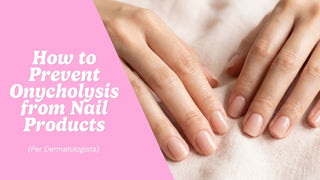
Onycholysis does not heal. It grows out.
When the nail plate lifts away from the nail bed, the two surfaces do not biologically reattach. The exposed bed keratinizes over and the lifted portion simply has to grow past the fingertip and be cut away. Fingernails grow about 3 to 3.5 mm per month, so distal-third onycholysis from one bad press-on removal takes 4 to 6 months to fully clear (Adamczyk, Journal of Cosmetic Dermatology, 2023).
This is why prevention is the entire game.
It is also why the rest of this article matters. In a 2024 survey of gel polish wearers cited in the Allermi review, 21.2% reported side effects during wear, 75.2% reported them after removal, and 3.1% had severe reactions including skin lesions, lip swelling, or widespread dermatitis. In 2022 the British Association of Dermatologists warned of a "tsunami of allergy" from gel polish, citing the rise in patch-test-confirmed methacrylate sensitization. The European baseline patch test series added 2-HEMA (2-hydroxyethyl methacrylate) in 2019 to keep up with how common the allergy had become (Aravind et al., JEADV Clinical Practice, 2026).
Onycholysis is the second-most-common nail diagnosis after onychomycosis in dermatology clinics (Aravind 2026). It is also one of the most preventable. Below are the six specific mechanisms by which nail products cause it, the dermatology-backed prevention rule for each, and how EyeCandys short press-ons are designed around all six.
What Onycholysis Actually Is
Onycholysis is the painless separation of the nail plate from the nail bed, starting at the distal (tip) edge and progressing proximally toward the cuticle. The lifted area appears white, yellow, or opaque against the surrounding pink attached nail bed.
It is often misdiagnosed as nail psoriasis or a fungal infection, especially when chronic, which delays correct treatment by months or years. One published case (PMC4857839) describes a 59-year-old patient treated unsuccessfully with acitretin and cyclosporine for nail psoriasis before her gel polish allergy was finally identified as the cause.
The clinical point that matters: once the plate has separated, the only cure is grow-out. Treatment is patience. Prevention is everything else.


Cause 1: Mechanical Trauma
The most common cause and the most avoidable. Four mechanisms drive it.
Lever-arm trauma during wear. Every millimeter of nail beyond the fingertip multiplies the force the tip transmits back into the hyponychium and onychodermal band when it bumps a counter, snags fabric, or catches a doorframe. A 1 cm overhang doubles the leverage of a 5 mm overhang. A 2 cm overhang quadruples it. Every keystroke, bag zip, hair brush, and cabinet door becomes a small mechanical insult to the seal that holds the plate to the bed.
Adhesive removal trauma. Acrylic, gel, and press-on adhesives bond to nail keratin. When the adhesive bond is stronger than the natural plate-bed bond, removal force lifts the plate up off the bed instead of the adhesive off the plate. This is the textbook mechanism for traumatic onycholysis (Rich et al., Journal of Clinical and Aesthetic Dermatology, 2018).
Direction of peel during removal. Pulling from the cuticle toward the tip transmits force into the matrix zone and propagates a separation wave across the entire bed. Pulling from the tip toward the cuticle concentrates damage at the free edge only. Cuticle-to-tip is much worse.
Dry prying without solvent soak. Cyanoacrylate (classic nail glue) and methacrylate-based gel both weaken in warm soapy water and cuticle oil. Dry prying maximizes peel force on the natural plate.
Prevention rule: Cap nail length at 2 mm of overhang. Soak 10 to 15 minutes in warm soapy water before removing any glued-on product. Flood the seam with jojoba or cuticle oil. Roll the press-on off side to side from the free edge. Never pry from the cuticle. File in one direction only, with a fine-grit or glass file.
Cause 2: Acrylate Contact Allergy
The fastest-growing cause and the most clinically serious because it is irreversible.
The dominant allergens, in order of how often they trigger patch-test reactions: 2-HEMA (2-hydroxyethyl methacrylate), EGDMA (ethylene glycol dimethacrylate), di-HEMA TMHDC, hydroxypropyl methacrylate, IBOA (isobornyl acrylate), TREGDA, the tosylamide formaldehyde resin in traditional polish, and methyl methacrylate in low-end or overseas acrylic systems. 2-HEMA is small enough to penetrate both the nail plate and the surrounding skin.
How it presents: itching, burning, or tight sensation around the nail folds and fingertips. Redness, swelling, and blistering of the lateral nail folds. The nail plate lifts from the bed in moderate-to-severe cases. Subungual hyperkeratosis (thickening under the nail) can mimic psoriasis. Onset is typically 24 to 48 hours after exposure, and the reaction worsens with each repeat exposure because sensitization is cumulative.
In severe cases the reaction can spread to the face (where the client touches her face), eyelids, neck, and even cause respiratory issues, documented across the Aravind 2026 systematic review.
"HEMA-free" is not methacrylate-free. Sensitization to one acrylate frequently leads to reactions against all of them. Di-HEMA TMHDC, EGDMA, hydroxypropyl methacrylate, IBOA, and TREGDA all cross-react in sensitized individuals. The only structural fix is products that do not use uncured or semi-cured methacrylate monomers at all.
The lifelong cost: once sensitized, the allergy is permanent and cross-reactive to dental composites, orthopedic bone cement, hearing aid adhesives, insulin pump adhesives, continuous glucose monitor adhesives, and medical wound glues. Patients have required dental procedure modifications after gel polish sensitization. A bad gel manicure can compromise your medical care for the rest of your life.
Prevention rule: Patch test new products on the inside of the wrist or elbow for 48 hours before nail application. Choose products that disclose full ingredient lists, not "free-from" marketing labels. Avoid at-home gel kits unless the brand publishes its cure timing and lamp wattage (under-curing is the primary route to monomer exposure). If you already have eczema, hand dermatitis, or any known cosmetic sensitivity, see a dermatologist for patch testing before any acrylate exposure.
Cause 3: Photo-Induced Damage from UV and LED Lamps
Two distinct mechanisms.
The first is direct UVA exposure to skin and nails from curing lamps. UV nail lamps emit primarily UVA in the 340 to 380 nm range (PMC11931093, International Journal of Dermatology scoping review, 2025). UVA penetrates skin deeply, damages collagen and elastin, and contributes to nonmelanoma skin cancer risk. The clinical-significance picture is mixed: a 2020 review by Schwartz et al. (PMC7492020) concluded "little to no carcinogenic risk inherent with UV gel manicures" at typical consumer use, while individual case reports of squamous cell carcinoma after years of frequent UV lamp use exist (Ratycz et al. 2019; Freeman et al. 2020). The mainstream position from MD Anderson, Cleveland Clinic, and the AAD is to treat it as a low-risk-but-real precaution: apply SPF 30+ to hands and fingertips, or wear UV-A protective fingerless gloves, before any gel manicure.
The second mechanism is photo-onycholysis from sun exposure of partially cured methacrylate polish. A Belgian case cited in Aravind 2026 describes a patient who developed periungual dermatitis and onycholysis after using a hybrid gel polish designed to cure under sunlight rather than a salon lamp. Incomplete curing left active monomers in the polish, and daylight finished the curing reaction on her nail. Niche but real.
Prevention rule: Apply broad-spectrum SPF 30+ or wear UV-A fingerless gloves before any gel manicure. Avoid "sunlight-cure" or hybrid gels that rely on ambient light. Choose LED lamps over older fluorescent UV lamps. Limit gel manicure frequency. Or skip the curing step entirely with a press-on system that does not require it.
Cause 4: Chemical Solvent Damage
The other half of the gel problem is what you use to remove it.
Acetone is the standard gel remover. Repeated 10 to 15 minute soaks dehydrate the nail plate, dissolve the lipid layers between keratin laminae, and cause cumulative onychoschizia (lamellar splitting). Onycholysis can follow when the solvent reaches the nail bed through compromised plate. Acetone appears in the patch-test screening series for nail-related dermatitis (Aravind 2026).
Methyl ethyl ketone (MEK) is documented in a case report titled "Methyl Ethyl Ketone-Related Loss of Matrix With Nail Onycholysis and Pterygium" (Forouzan and Cohen, Cureus, 2020). MEK exposure caused matrix loss, onycholysis, and pterygium (scar tissue bridging the nail bed and proximal nail fold). Industrial risk, but documented.
Non-acetone removers use ethyl acetate or isopropyl alcohol. Gentler on nails, slower at removing gel.
Prevention rule: Limit acetone exposure. Use the foil-wrap method instead of dunking the whole finger. Use non-acetone remover for standard polish. Apply cuticle oil immediately after every acetone exposure to restore the lipid layer. Take a 1 to 2 week break with no polish between gel sets to let the plate rehydrate. Never scrape softened gel with metal tools; use a wood orange stick.
Cause 5: Microbial Superinfection (Green Nail Syndrome)
Once a nail is even slightly lifted, the gap becomes a microbial habitat. The two offenders to know are Pseudomonas aeruginosa and Candida.
Pseudomonas aeruginosa causes the characteristic green to blue-green discoloration of green nail syndrome (chloronychia). It thrives in warm, moist environments under lifted nails. Risk factors documented in the literature include artificial nails of every kind, prolonged water exposure, and onycholysis itself as the entry point (Chiriac et al., Clinical Interventions in Aging, 2015). A 2024 literature review specifically flagged press-on nails as a documented trigger. Treatment usually requires cutting off the detached portion of the nail plate plus topical antibiotics (ciprofloxacin 0.3% drops, gentamicin ointment), with oral fluoroquinolones in resistant cases.
Candida species cause chronic paronychia and onycholysis through the same moisture-trap mechanism. Common in bartenders, dishwashers, healthcare workers, and anyone with chronic hand-in-water exposure.
The vicious cycle: nail lifts mechanically or allergically. Moisture gets in. Pseudomonas or Candida colonizes the pocket. Infection produces inflammation that widens the lift. Onycholysis progresses proximally.
Prevention rule: Never apply press-ons or artificial nails over an existing lifted area. Dry hands thoroughly after washing, including tapping under the free edge with a towel. Wear cotton-lined rubber gloves for dishes, hair washing, and cleaning. If a press-on lifts even slightly during wear, remove it the same day rather than waiting it out. Apply oil to the surrounding cuticle skin, never into a lifted area (trapped oil holds moisture against the bed). If green, yellow, or black discoloration appears, see a dermatologist. Over-the-counter antifungals do not treat Pseudomonas.
Cause 6: Improper Sizing and Application
Less discussed than the chemistry, mechanically just as damaging.
Width problems come in two flavors. Too wide and the press-on extends onto the skin of the lateral nail folds, breaking the bond at the edges, trapping moisture, and applying lateral peel force during wear. The AAD position is unambiguous: a fit that avoids skin contact is one of the most important factors in preventing nail infections and adhesive failures. Too narrow and there are visible gaps between the press-on edge and the natural nail's lateral walls, letting moisture and dirt penetrate, weakening the bond, and inviting microbial colonization.
Length problems are covered in the next section.
Application hygiene mistakes that compound the rest: pressing onto a nail with cuticle oil or polish residue, skipping the dehydrator or alcohol wipe (which leaves a moisture film bacteria can use later), using contaminated tools, and pressing too hard during application (which pushes air pockets to the edges where they become moisture pockets).
Prevention rule: Measure both length and width of every nail before buying. Choose a brand that publishes a millimeter-precise size chart (the standard is 7 mm to 17 mm in 1 mm increments). Clean the natural nail with alcohol or a dehydrator before application. Use clean tools. When between two sizes, size down for a cuticle-hugging fit. If you size up, file the sides down immediately before applying.
The Length Rule: How Many Millimeters Is Safe?
This is the most concrete, citable number in the entire prevention story. Three convergent sources land on it.
Shirato et al. (Journal of Physical Therapy Science, 2017) found that 2 mm beyond the fingertip produced peak dexterity on the STEF hand-function test. Uetake (2000) set the practical ceiling at 2 mm for work efficiency. Jansen et al. (Journal of Hand Therapy, 2000) tested artificial nails at 5, 10, and 20 mm and found dexterity falling at every step up. The AAD's public guidance on healthy nails sits in the same range.
The consensus number for daily wear is 2 mm beyond the fingertip. 5 mm is the maximum acceptable before mechanical and infection risks rise sharply. For recovering or sensitive nails, stay at 0 to 2 mm until full regrowth (4 to 6 months for distal onycholysis). Any extra overhang during regrowth is unnecessary lever-arm risk on already-compromised attachment.
The product implication is direct. A press-on with a 1 cm overhang is past the Jansen cap and five times the AAD recommendation. A press-on with a 2 mm overhang is the only length range dermatology literature actually endorses. EyeCandys short press-ons are designed at this length on purpose.

How to Measure Your Nails Before Buying
This is the practical prevention step most readers skip.
You need a soft (flexible) measuring tape, or a thin strip of paper plus a millimeter ruler. A pen. A notebook for ten measurements.
For width, find the widest part of your nail plate (usually just above the cuticle line). Press the soft tape firmly across the nail surface, following the natural curve of the nail. Do not pull it straight across in a chord. Three-dimensional nail surfaces measured as straight lines come up under-sized. Mark the two edges where the nail meets skin. Read the distance in millimeters. Record for all ten fingers. They will all be different. Your dominant hand is often slightly wider on the same finger.
For length, measure your existing free edge in millimeters and decide your target overhang. The recommended starting point is 2 mm. For special occasions, up to 5 mm is acceptable. Beyond 5 mm is outside the dermatology-recommended range.
The typical XS to XL labeling on press-on packaging refers to the extension past the fingertip, not total nail length. XS (1 to 2 mm) is the dermatology-recommended range for daily wear and recovery. S (2 to 4 mm) is practical everyday wear in the safer range. M (5 to 7 mm) starts adding lever-arm risk. L and XL (8 mm+) are outside the derm range and only appropriate for short-term events.
Common sizing mistakes to flag: estimating by eye, measuring only one hand, using a rigid ruler, buying by size label without checking the brand's mm chart, and choosing length based on photos instead of actual mm specs.

When to Stop Everything and See a Dermatologist
These are the red flags. Any of them means stop, do not reapply, and book a derm appointment.
Itching, burning, or tightness around the nail folds within 48 hours of application. Spreading dermatitis to the face, eyelids, or other body areas. Visible nail lifting (a white or opaque area where the nail used to be pink). Green, yellow, or black discoloration in the lifted area. Pain, throbbing, or swelling at the cuticle. Horizontal grooves (Beau's lines) emerging from the cuticle 2 to 3 months after a bad set (matrix damage). Subungual hyperkeratosis (thickening under the nail) that does not resolve.
Patch testing for nail-related dermatitis at a derm clinic should include the acrylates and methacrylates series, tosylamide, formaldehyde, and the solvent series.

How EyeCandys Short Press-Ons Are Designed Around All Six Causes
EyeCandys short press-ons sit in the 2 mm dermatology sweet spot, not past it. Lower torque on the distal seal, less subungual area for bacteria, less mechanical pressure on the matrix. The first cause is engineered out by length alone.
The adhesive system addresses the second. EyeCandys Insanely Sticky Tabs are resin-based, not acrylate-based. The adhesive is free of methyl methacrylate (MMA), 4-methoxyphenol (MEHQ), dibutyl phthalate, toluene, formaldehyde, formaldehyde resin, camphor, parabens, and xylene. There is no UV curing step, no fume exposure, and no uncured or semi-cured methacrylate monomer touching skin or nail plate. The tabs are rated safe to wear during pregnancy. For customers with a diagnosed acrylate allergy, the tabs alone are the application method. Skip the optional cyanoacrylate glue method entirely.
The third cause is addressed structurally. No UV lamp is required for application, which removes the UVA exposure to the dorsal hand and eliminates the partial-cure photo-onycholysis risk in one move.
The fourth cause, solvent damage, is mitigated by the soak-and-roll removal protocol. Soak in warm soapy water for 10 to 15 minutes. Flood the seam with cuticle oil. Roll the press-on off side to side from the free edge. No acetone bath. No metal scraping. The protocol ships with every set and is on every product page.
The fifth cause, microbial superinfection, is reduced upstream by all of the above (fewer lifted areas, no moisture-trapping acetone exposure) and by removing any press-on the same day it lifts rather than letting the gap become a habitat.
The sixth cause, sizing, is addressed by a published 1 mm-increment size chart and by the cuticle-hugging fit. Each EyeCandys set is hand-buffed at the cuticle edge for a flush, no-lift fit, and tapered thinner at the base than the tip. The geometry directs wear force toward the impact-resistant tip rather than the seal-vulnerable base.
Sets are reusable up to four times when removed correctly, which brings the cost per wear to around $6.50.
Browse the full collection.
Short by design, in the 2 mm dermatology range. Resin-based Insanely Sticky Tabs with no methyl methacrylate, no MEHQ, no formaldehyde, no UV curing. Safe to wear during pregnancy.
Shop Press-On NailsThe Prevention Checklist
Before applying any nail product: patch test new chemistry 48 hours in advance on the inside of the wrist or elbow. Confirm the product discloses its full ingredient list, not just "free-from" marketing. Verify your tools are clean and unshared. Measure each natural nail (width in mm, decide target overhang in mm). If using press-ons, confirm width matches edge to edge with no skin overlap. If using gel, apply SPF 30+ or UV-A gloves before lamp exposure. Clean and dehydrate the natural nail with an alcohol wipe or dedicated dehydrator.
During wear: limit cyanoacrylate-based press-on wear to single events or up to 3 weeks with the EyeCandys glue method. Limit gel polish wear to 2 to 3 weeks. Remove immediately if lifting, a gap, or discoloration appears. Apply cuticle oil daily to the skin around (never into) the product. Wear gloves for wet work. Stop using your fingernails as tools.
During removal: warm soapy water soak for 10 to 15 minutes. Flood the seam with cuticle oil. Roll the product off side to side from the free edge. Never dry-pry from the cuticle. Use non-acetone remover when possible, or the foil-wrap method to limit acetone exposure. Apply cuticle oil immediately after removal.
Between sets: 1 to 2 week break minimum to let the plate rehydrate. Keep nails short (2 mm overhang max). File in one direction with a fine-grit or glass file. Round or buff sharp corners. Daily cuticle oil. Do not push or cut cuticles.
Frequently Asked Questions
How long does onycholysis take to heal?
It does not heal in the conventional sense. The lifted plate has to grow out. Fingernails grow about 3 to 3.5 mm per month, so distal-third onycholysis typically clears in 4 to 6 months. Keep the affected nail short, skip nail products on the lifted area for at least 4 weeks, and apply cuticle oil to the surrounding skin only.
Is "HEMA-free" gel polish safe if I am sensitized to acrylates?
No. Once sensitized to one acrylate, you frequently cross-react to all of them, including di-HEMA TMHDC, EGDMA, hydroxypropyl methacrylate, IBOA, and TREGDA. "HEMA-free" replaces one specific molecule but leaves the chemistry class intact. The only structural fix is products that use no uncured or semi-cured methacrylate monomers at all.
Are press-on nails safer than gel polish?
The category is not inherently safer or more dangerous. The mechanism is what determines risk. A press-on applied with a cyanoacrylate-heavy nail glue or an IBOA-containing adjunct can sensitize you. A press-on applied with a resin-based adhesive, fitted to the natural nail edge to edge, kept at 2 mm of overhang, and removed by soaking rather than prying carries far less risk than the average gel set. EyeCandys is built around the latter version.
Can I wear press-ons if I have an acrylate allergy?
Use the resin-based Insanely Sticky Tabs alone, with no nail glue. Skip the optional cyanoacrylate method entirely. Patch test the tab adhesive on the inside of your wrist for 48 hours before applying to your nails the first time.
What is the dermatology-recommended length for daily nail wear?
2 mm of free edge past the fingertip. This is the figure that converges across Shirato et al. (2017), Uetake (2000), the AAD's public guidance, and dermatologist Rajani Katta's clinical recommendation. 5 mm is the maximum acceptable before risk rises sharply. For recovering nails, stay at 0 to 2 mm until full regrowth.
What is the safest way to remove a press-on?
Soak in warm soapy water for 10 to 15 minutes. Flood the seam with cuticle oil. Roll the press-on side to side from the free edge. Never dry-pry from the cuticle. Pulling from the cuticle direction is what transmits force into the matrix and causes traumatic onycholysis.


The 2 mm sweet spot, engineered.
Hand-painted salon-gel press-ons with resin-based tabs. No MMA, MEHQ, formaldehyde, or UV curing required. Reusable up to 4 wears at around $6.50 per wear.