


Study-Session Essentials: Blue-Light Glasses for Late-Night Cramming
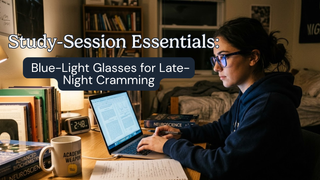
There’s a very specific kind of late-night studying where everything is quiet, your brain is finally cooperating, and you swear you can feel yourself becoming an academic weapon. Then your eyes start doing that thing. Text gets a little fuzzy. You blink and it clears, then blurs again. Your eyelids feel heavy. Your forehead starts to tighten like a slow, annoying drumbeat. And suddenly the only thing you can think is, “Why does my face hurt.”
If you’ve been eyeing blue-light glasses as the solution, you’re not wrong to consider them. They can make screens feel less harsh for some people, especially at night. But the bigger truth is that late-night eye strain usually isn’t one problem. It’s a stack of small problems that pile up until your eyes wave a tiny white flag.
So let’s talk about what’s actually going on during marathon study sessions, where blue-light glasses fit in, how to choose a pair that won’t end up abandoned on your desk, and what else to do alongside them so your eyes feel normal again.
Why your eyes get cranky during late-night studying
Most “digital eye strain” isn’t your eyes being damaged by your laptop. It’s your eyes being overworked by the way you’re using it.
A few common culprits tend to show up together.
Your screen is too bright for the room
- If the room is dark and your screen is basically a flashlight, your eyes are constantly adapting to that contrast. It’s like staring at a tiny billboard in a cave.
You’re blinking less than you think
- When you’re focused, you blink less and your blinks are often incomplete. That’s a one-way ticket to dryness, burning, watering, and the “sand in my eyes” feeling.
You’re locked into near focus for a long time
- Studying is sustained close-up work. Your focusing system is doing the same job nonstop. That can show up as headaches, tired eyes, or blur that comes and goes.
Glare is quietly making everything worse
- Overhead lights, a desk lamp positioned wrong, a window reflection, or a glossy screen can add enough glare to make your eyes work harder without you realizing why.
Your prescription might be slightly off
- Even a small amount of uncorrected astigmatism or a prescription that’s “mostly fine” can feel brutal during long near-work sessions. Studying is where tiny vision issues become loud.
This is why blue-light glasses sometimes help and sometimes don’t. If glare and harsh brightness are your main problems, you might feel real relief. If your main problem is dryness or an outdated prescription, blue-light filtering alone won’t be the hero.
Blue light, explained like a normal person
Blue light is just part of visible light. The sun is a major source of it, and during the day that’s totally normal. Screens and LED lighting also give off blue-heavy light, and at night your eyes and brain tend to be more sensitive to bright, cool-toned light.
Here’s the part people confuse. “Blue light” isn’t the only reason screens feel uncomfortable. Screens are bright, high-contrast, and close to your face. That combination is what makes your eyes tired. Blue-light glasses can soften the experience, but they’re only one piece of the comfort puzzle.
What blue-light glasses actually do
Blue-light glasses usually do two things.
- They filter some blue wavelengths
- This can make the screen feel less sharp-edged or less “glary” to some people, especially late at night.
- They often include anti-reflective coating
This is the underrated part. A good anti-reflective coating reduces reflections from screens and overhead lighting. For a lot of people, that’s the difference between “my eyes are on fire” and “I can finish this chapter.”
If you’ve ever wondered, “Do I even need blue-light glasses?” the most helpful version of that question is: “Do screens feel harsh and glary to me, especially at night?” If yes, they’re worth trying. If not, you might get more mileage out of better lighting, screen settings, and breaks.
Also, if you don’t wear glasses normally, you’re not going to “mess up your eyes” by wearing non-prescription blue-light glasses. The main risk is buying a cheap pair with weird optics that makes you feel off. If you ever put a pair on and feel dizzy or like the room is slightly swimming, that’s not you being dramatic. That’s usually low-quality lenses.
Late-night studying and sleep
Even if your eyes feel fine, your brain might not.
Bright light at night can make it harder to wind down. Blue-heavy light can influence your sleep timing because your body uses light cues to decide whether it’s daytime or bedtime. That doesn’t mean blue-light glasses will fix your sleep, but they can be part of a setup that makes it easier to transition from “research mode” to “sleep mode.”
If you’re studying late and want to fall asleep afterward, stack your odds like this.
Turn on night mode or a warm color temperature setting
Lower brightness more than you think you need
Use a lamp for soft ambient light so the screen isn’t the only light source
Try to give yourself 15 to 30 minutes of low-stimulation time before bed if you can
If you’re closing your laptop at 1:07 a.m. and immediately trying to sleep at 1:08 a.m., even the best glasses in the world are going to struggle.
Choosing the right pair for studying
A good pair for studying is less about hype and more about comfort and clarity.
Clear vs amber lenses
- Clear lenses are great if you want something you can wear anytime without colors looking weird. They usually filter less blue light but still help with comfort, especially if they have a good anti-reflective coating.
- Amber or more tinted lenses often feel amazing at night because they create a warmer view and can reduce that “cold bright screen” feeling. The tradeoff is that colors shift. If you’re doing anything where accurate color matters, amber lenses can be annoying.
Anti-reflective coating matters more than you think
- If you only prioritize one feature, make it anti-reflective. It reduces glare and reflections, which is a major reason screens feel tiring.
Prescription vs non-prescription
- If you already wear glasses sometimes, don’t assume you can just throw non-prescription blue-light glasses on top of everything. If you need correction and you don’t have it while studying, your eyes will fight you all night.
- If you wear contacts, you can absolutely wear blue-light glasses with contacts. A lot of contact wearers like them because they reduce glare and can make eyes feel less fatigued during long screen sessions.
Fit matters because you’ll be wearing them for hours
- If they pinch your nose, slide down constantly, or squeeze your temples, you’ll stop wearing them. Lightweight frames and a stable fit win.
Lens quality matters
- Cheap lenses can introduce subtle distortion, especially at the edges. If you feel dizzy or off, swap them for a better pair.
How to use them in a way that actually helps
If you put blue-light glasses on and change nothing else, you might get a small comfort boost. If you put them on and also fix the obvious strain triggers, that’s when they really earn their keep.
Try this late-night setup.
- Put the glasses on 30 to 60 minutes before you’re deep into screens
- Turn on night mode or warm color settings
- Lower brightness and increase text size instead of leaning closer
- Keep your screen about an arm’s length away
- Position your screen slightly below eye level
- Use a lamp or ambient light so you’re not studying in a dark room
- That “screen slightly below eye level” detail helps because when your screen is too high, your eyes are open wider and dryness gets worse.
The study-session comfort checklist
Breaks that your brain will actually do
- The classic advice is the 20-20-20 thing: every 20 minutes, look 20 feet away for 20 seconds. It works because it lets your focusing system relax. If you won’t remember, set a silent timer.
- Blink like you mean it
When your eyes feel dry, do a quick blink reset: slow, complete blinks for 10 seconds. This can help clear intermittent blur too.
- Fix airflow
If a fan or vent is blowing toward your face, dryness ramps up fast. Move the airflow, not your face. And drink water.
- Use drops if you need them
Artificial tears can be helpful. If you’re using drops frequently, preservative-free options are often gentler. If you wear contacts, pick drops labeled safe for contacts.
- Make the lighting make sense
Studying in darkness with a bright screen is a strain multiplier. Add a lamp, but place it so it doesn’t reflect on your screen.
- Unclench your posture
A lot of “eye strain” headaches are partly neck and shoulder tension. Reset your posture occasionally.
When blue-light glasses aren’t enough
If you’re doing the right things and your eyes still feel miserable, that’s usually a sign that something else needs attention.
Consider an eye exam if:
- You get headaches almost every time you study
- You’re squinting to keep text clear
- Your vision blurs on and off during near work
- One eye feels noticeably more tired than the other
- Your eyes burn or feel gritty most days
- You struggle to refocus when you look up from the screen
- Symptoms persist even after better lighting and breaks
Sometimes the fix is simple: a small prescription update, a near-work lens option designed for screen distance, or dry eye support. And yes, people under 40 can benefit from lenses designed for near work if they’re living on screens.
A quick reality check
Blue-light glasses can help screens feel less harsh at night and reduce glare. They can’t replace breaks, fix studying in a pitch-dark room, correct an outdated prescription, or undo sleep deprivation.
If you want the best results, don’t treat them like a single solution. Treat them like part of a late-night study kit.