

About half of all vision loss and blindness is preventable — but only if problems get caught early. The most reliable way to catch them early is a comprehensive eye exam. The catch? Most people either don't go often enough or have no idea what "often enough" even means for their age and situation.
This guide lays out exactly how frequently you should be seeing an eye doctor, broken down by age group and risk factor, based on the latest guidance from the American Optometric Association (AOA) and the American Academy of Ophthalmology (AAO).
Why eye exams are about more than seeing clearly
A lot of people assume an eye exam is just about updating a prescription. It's not. A comprehensive eye exam checks the health of your entire eye — including the retina, optic nerve, and blood vessels — and can pick up early signs of conditions like glaucoma, macular degeneration, diabetic retinopathy, even signs of hypertension and certain neurological issues.
The problem is that most serious eye diseases develop silently. Glaucoma, for example, is often called the "silent thief of sight" because it causes irreversible optic nerve damage and vision loss with no pain and no obvious symptoms until vision is already gone. Regular exams are the only reliable way to intervene early.
Eye exam frequency by age
| Age group | Frequency | Notes |
|---|---|---|
| Infants 0–12 mo | 6–12 months of age once | First comprehensive exam with optometrist or ophthalmologist — not a pediatrician check |
| Children 3–5 | Once in this window once | At-risk children may need more frequent visits |
| Ages 6–17 | Annually annual | One exam before first grade, then yearly. School screenings do not substitute. |
| Adults 18–64 (AOA) | Annually annual | 2024 update: annual for all adults regardless of risk status |
| Adults 18–64 (AAO) | Every 2–10 yrs risk-based | <40: 5–10 yrs | 40–54: 2–4 yrs | 55–64: 1–3 yrs. Baseline at 40 for all adults. |
| Adults 65+ | Every 1–2 years annual | AOA recommends annually. AAO: 1–2 yrs even without symptoms. |
Infants (0–12 months)
According to the AOA, infants should have a comprehensive eye exam between 6 and 12 months of age. Vision development starts immediately after birth, and undetected problems like misalignment or lazy eye (amblyopia) become harder to treat the longer they go unaddressed.
Note: a pediatrician's basic vision check is not the same as a comprehensive eye exam performed by an optometrist or ophthalmologist.
Children ages 3–5
The AOA recommends one visit between the ages of 3 and 5. At-risk children may need to be seen more frequently depending on their specific risk factors and any identified vision conditions.
School-age children (ages 6–17)
Both low-risk and at-risk children should see an eye doctor once before entering first grade and then annually through age 17. Vision changes frequently during the school years, and poor uncorrected vision directly impacts reading ability, academic performance, and screen tolerance. School vision screenings identify some problems but are not a substitute for a full clinical exam.
Adults ages 18–64
This is where the guidance has recently shifted. The AOA updated its guidelines in 2024 to recommend annual eye exams for all adults 18 and older. Previously, low-risk adults in this age range were recommended an exam every two years. The reasoning: more frequent exams can help prevent younger adults from developing eye diseases later in life.
The AAO takes a slightly more conservative position for asymptomatic patients with no risk factors. Their guidance recommends: under 40 years — every 5 to 10 years; 40 to 54 years — every 2 to 4 years; 55 to 64 years — every 1 to 3 years. The AAO also recommends a baseline comprehensive eye disease screening at age 40 for all adults, even those with no symptoms.
In practice, annual exams are the safer and more widely recommended default, especially for anyone wearing contact lenses or glasses.
Adults 65 and older
For individuals 65 and older, the AAO recommends an examination every 1 to 2 years, even in the absence of symptoms. The AOA recommends annual visits for all older adults, regardless of risk status. The prevalence of cataracts, glaucoma, macular degeneration, and diabetic retinopathy rises substantially in this age group, making consistent monitoring non-negotiable.
Who needs more frequent exams?
Regardless of where you fall in the age brackets above, certain situations push your recommended exam frequency to annual or more:
Contact lens wearers. Contact lenses sit directly on the cornea and change the oxygen environment of the eye. Annual exams are strongly recommended for contact lens wearers, who need monitoring for lens-related complications, correct fit, and prescription accuracy.
Diabetes. People with Type 1 diabetes should have their first eye exam within 5 years of diagnosis, followed by annual exams. For Type 2 diabetes, an eye exam is recommended at the time of diagnosis, then annually thereafter. Diabetic retinopathy — the most common microvascular complication of diabetes — can progress to vision loss without any noticeable early symptoms.
Pregnancy with diabetes. Pregnant women with diabetes should schedule an eye exam within the first trimester of pregnancy, then again one year postpartum. Hormonal changes during pregnancy can accelerate the progression of diabetic eye disease.
Family history of glaucoma or macular degeneration. For young individuals at higher risk — such as African Americans, who face elevated risk of glaucoma — comprehensive eye exams should be considered every 2 to 4 years for those under 40, and every 1 to 3 years between ages 40 and 54.
High myopia. People with high myopia (typically -6.00 D or more) face elevated risk of retinal detachment, glaucoma, and macular issues. Annual exams are standard.
Hypertension and autoimmune conditions. Elevated blood pressure and conditions like lupus or rheumatoid arthritis can affect the blood vessels and structures of the eye.
AOA vs. AAO: what each body recommends
Signs you should see an eye doctor sooner
Don't wait for your next scheduled appointment if you experience any of the following:
- Sudden blurry vision or vision loss in one or both eyes
- Flashes of light or a sudden increase in floaters
- Eye pain or persistent redness
- Double vision
- Halos around lights, especially at night
- Frequent headaches linked to eye strain
- Noticeably worsening night vision
These can indicate conditions that need prompt attention and shouldn't be managed on a routine exam schedule.
What happens at a comprehensive eye exam
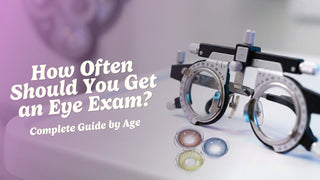
If you haven't had one recently, a comprehensive eye exam typically includes:
Visual acuity test — the standard chart reading at distance and near. This establishes your current prescription baseline.
Refraction — determines your exact prescription for glasses or contact lenses.
Slit-lamp exam — a microscope examination of the front structures of your eye: cornea, lens, iris.
Intraocular pressure (IOP) measurement — screens for glaucoma risk.
Dilated fundus exam — the back of your eye (retina, optic nerve, macula) is examined with dilating drops. This is the part most people skip when they only get a "vision test."
Color vision and peripheral vision testing — can detect neurological and retinal issues.
A full exam takes 45 minutes to an hour. The dilated portion causes blurry close vision for a few hours afterward, so plan accordingly.
Contact lens wearers: your exam schedule is different
If you wear contact lenses — whether prescription correction contacts or colored contacts — your exam schedule is not optional or negotiable. Here's why:
A contact lens fitting exam goes beyond a standard refraction. Your eye doctor measures base curve and diameter to ensure the lens sits correctly on your cornea, assesses your tear film quality (dry eye is a common issue for lens wearers), and checks for any signs of corneal hypoxia or lens-related inflammation.
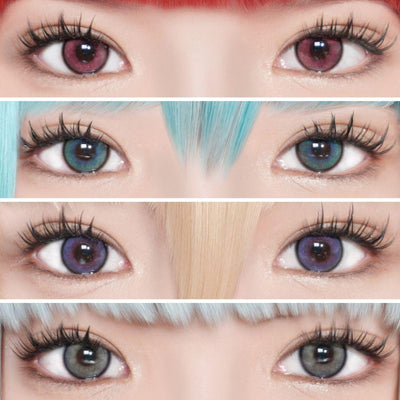
An outdated contact lens prescription doesn't just mean suboptimal vision — it can mean wearing lenses that don't fit properly, which over time affects corneal health. This applies to colored contact lenses exactly the same as clear prescription lenses.
At EyeCandys, all colored contact lenses require a valid prescription, and that prescription needs to stay current. Whether you're wearing our lenses for vision correction or for a look you love, keep your eye exam up to date — annually is the right cadence. Explore our full collection of colored contact lenses once you've confirmed your prescription is current.
Prescription current? Find your next look.
A complete age-by-age guide to eye exam frequency, covering AOA and AAO recommendations for infants, children, adults, seniors, contact lens wearers, and high-risk groups.