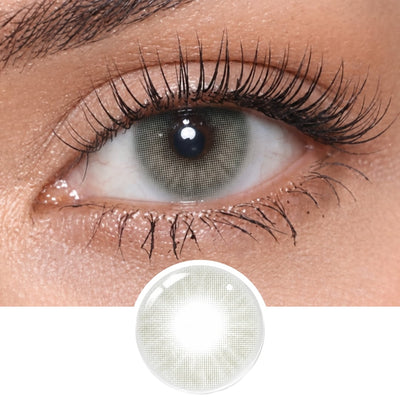
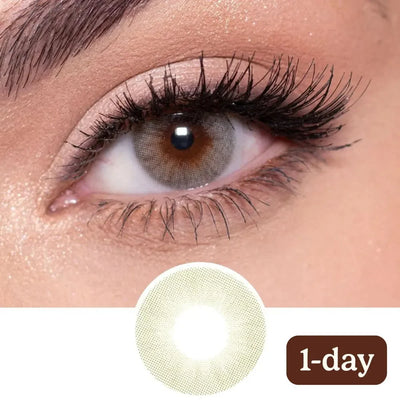


Colored contacts with astigmatism come with an extra decision: the same shade often appears twice, once as a regular lens and once as a toric lens. The difference between toric vs regular colored contacts comes down to one line of your prescription, the cylinder (CYL) value. If your eye doctor wrote a cylinder value that needs correcting, you need a toric colored contact for that eye. If the CYL line is blank, regular colored contacts fit. The sections below cover where the cutoff sits, how rotation works, and what changes in color range, price and wait time.
How to Read Your Prescription for Toric or Regular Lenses
A prescription for astigmatism carries three numbers. Sphere shows whether you are nearsighted or farsighted. Cylinder measures how much astigmatism you have, which comes from a cornea, or a lens inside the eye, that is more oval than round [1]. Axis, written in degrees from 0 to 180, marks where on the cornea the astigmatism sits.
A regular colored contact is made to a sphere value only. A toric colored contact is made to all three numbers, so it is matched to your sphere, cylinder and axis values for each eye. Non-prescription (plano) colored contacts have none of the three.
If you are unsure how to read your own numbers, the guide to decoding eye prescriptions walks through each abbreviation.
Toric vs Regular Colored Contacts at a Glance
| Regular colored contacts | Toric colored contacts | |
|---|---|---|
| Prescription values | Sphere only, or none for plano | Sphere, cylinder and axis |
| Designed to correct astigmatism | No | Yes, when the prescription matches |
| Position on the eye | Free to turn | Must stay aligned to the axis |
| Color choice | The full colored contacts range | The astigmatism collection, a smaller set |
| Dispatch | See the product page | Most made to order, 1–2 weeks of production before dispatch |
The last two rows are the ones shoppers feel first, and they are covered in detail below.
The Cylinder Threshold: When Regular Lenses Stop Being Enough
The American Academy of Ophthalmology reports that most people have between 0.5 and 0.75 diopters of astigmatism, and that a measurement of 1.5 or more typically calls for contacts or eyeglasses to see clearly [2]. No single number flips a switch between regular and toric, because the fitting decision belongs to your eye doctor. The research does show where the answer starts to tilt.
In a 2010 hospital study of soft lenses, patients with 0.75 to 1.25 diopters of corneal astigmatism wore either toric or spherical lenses. Cylindric and keratometric astigmatism dropped significantly with the toric lenses. With the spherical lenses, the cylindric astigmatism did not change [3]. A 2023 study of 384 patients concluded that people with low to moderate astigmatism should prefer soft toric lenses, and it cites survey data that about 45% of contact lens wearers have 0.75 diopters of astigmatism or more [4].
In practice, that makes 0.75 diopters the point to raise with your doctor, and 1.50 diopters the point where correction is typically needed. For a cylinder that high, a soft contact that corrects it will be a toric. For background on how the lens works, read what toric contact lenses are and what astigmatism is.

Rotation: Why Toric Colored Lenses Have to Stay Put
A regular lens can turn a few degrees on the eye without changing your vision, because it has the same power in every direction. A toric lens has power in one direction only, so the axis must line up with the axis of your cornea. That is why toric lenses are built with orientation control. The EyeCandys astigmatism collection describes its lenses as built to maintain proper alignment on the eye.
Alignment is never perfect. Researchers note that a toric lens settles into position after a blink, and each blink can cause a small rotation that makes visual quality fluctuate [4]. A well-fitted lens settles fast and stays settled. A poorly fitted one drifts, and the signs are vision that clears and blurs from blink to blink or a lens that feels off-center.
Fit is not a one-time check. Regular check-ups help make sure your contact lenses are still suitable for your eyes [5]. If a first pair of toric colored contacts shifts, tell your eye doctor. A different lens design is often the fix.

Color Range: Fewer Toric Choices, but Real Ones
Astigmatic prescriptions require precise parameters, so the toric selection is smaller. The colored contacts for astigmatism collection holds a much smaller set of lenses than the main colored contacts collection.
The EyeCandys toric range still covers the main natural color families: green, hazel, grey and brown. Choices include Desire Lush Green Toric, Pink Label Pure Hazel, Pink Label Eyelighter Grey and Pink Label Truffle Brown, and the Pink Label lenses are custom torics made to your sphere, cylinder and axis values.

Price: What to Compare Before You Add to Cart
No single toric premium applies across the store, because price follows the brand and lens line. Three details on each product page make the comparison fair: the price per pair, the replacement schedule the listing states, and how many lenses come in the box. A lens sold as a yearly pair and a lens sold as a 30-pack are priced for different jobs.
The same logic applies when you set a toric against a regular lens of the same shade. Compare cost per month of wear, not the number on the box. The guide to how much colored contacts cost explains which factors move the price.
Wait Time: Plan Ahead for Made-to-Order Torics
Toric colored contacts are the slowest part of this comparison. The astigmatism collection states: "Because astigmatic prescriptions require precise parameters, most lenses in this collection are made to order. Please allow an average production time of 1–2 weeks before dispatch, regardless of shipping speed selected."
That condition matters. Paying for faster shipping speeds up delivery only after the lens is made, so the production time comes first. For an event, a photo shoot or a convention, order at least a few weeks ahead. For a regular colored contact, check the dispatch estimate on the product page, since it varies by lens.
Which One Your Eyes Need: A Quick Decision Guide
If your prescription shows no cylinder for either eye, regular colored contacts are the right match, and you can browse the full colored contacts range or the prescription colored contacts collection.
If you have a small cylinder, around 0.75 to 1.25 diopters, ask your eye doctor directly whether a toric lens would serve you better than a spherical one. The research above suggests it often does, and the answer depends on your axis and how the lens fits.
If your cylinder is 1.50 diopters or higher in either eye, shop the colored contacts for astigmatism collection and have your full prescription ready, including axis. If you are not sure where to start with a prescription, the guide to choosing prescription colored contacts covers what to look for.

Related Reading
- What are Toric Contact Lenses?
- What is Astigmatism and How Do I Know If I Have It?
- Picking the Right Prescription Colored Contacts: What to Look For
- Decoding Eye Prescriptions: A Simple Guide for Contact Lens Wearers
Final Thoughts
Your cylinder value decides this choice. A blank CYL line points to regular colored contacts, a value of 0.75 diopters or more is worth a direct question to your eye doctor, and 1.50 diopters or more calls for a toric lens. Plan on a smaller color selection and a production wait with torics, and check early that your first pair stays aligned.
FAQ
What is the difference between toric and regular colored contacts?
Regular colored contacts are made to a sphere value only. Toric colored contacts are also made to your cylinder and axis values, so they correct astigmatism and have to stay aligned on the eye.
Can you wear regular colored contacts with astigmatism?
It depends on the cylinder. In one study of people with 0.75 to 1.25 diopters of astigmatism, toric lenses reduced cylindric astigmatism and spherical lenses did not [3]. Your eye doctor makes the call after a fitting.
Do toric colored contacts rotate?
A small amount of movement after a blink is normal, and it can make vision fluctuate briefly [4]. A lens that keeps drifting or leaves your vision unstable needs a follow-up with your eye doctor.
How long do toric colored contacts take to arrive?
The EyeCandys astigmatism collection states that most lenses are made to order, with an average production time of 1–2 weeks before dispatch, regardless of the shipping speed selected.
Sources
- Canadian Association of Optometrists. Astigmatism. https://opto.ca/eye-health-library/astigmatism
- American Academy of Ophthalmology. What Do Astigmatism Measurements Mean? https://www.aao.org/eye-health/tips-prevention/what-do-astigmatism-measurements-mean
- Kurna SA, Sengor T, Un M, Aki S. Success rates in the correction of astigmatism with toric and spherical soft contact lens fittings. Clinical Ophthalmology. 2010. https://pmc.ncbi.nlm.nih.gov/articles/PMC2938274/
- Zhang GY, Ye L, Wang WJ, et al. Effectiveness of toric soft contact lenses for vision correction in patients with different degrees of astigmatism: a real-world study. International Journal of Ophthalmology. 2023. https://pmc.ncbi.nlm.nih.gov/articles/PMC10626351/
- The College of Optometrists. Contact lenses. Look After Your Eyes. https://lookafteryoureyes.org/eye-care/contact-lenses/
Colored Contacts Made for Astigmatism
Have your prescription ready, including cylinder and axis, and browse toric colored contacts built for astigmatism.
Rated 4.8 stars from 6,900+ reviews.